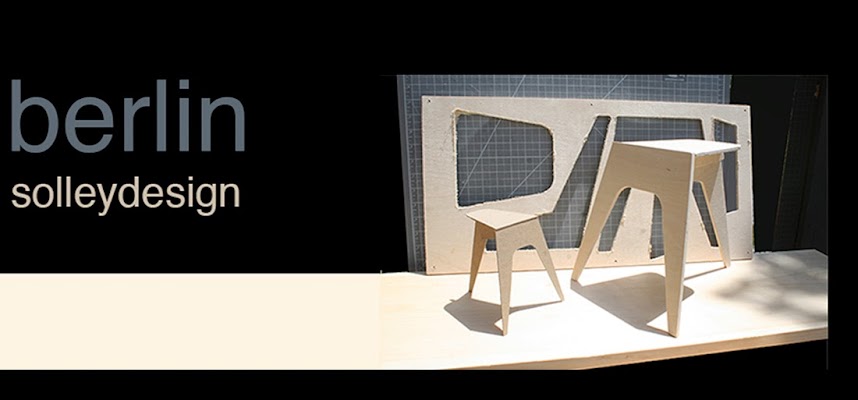
Back in the USA, the STP stool will soon be manufactured locally. Fabrication begins in the first week of October 2015. For information on availability and costing, please visit our website.
The little brother of the PCH chair also made it's debut in Berlin. The tension straps prove really successful in distributing load across the stool making in very robust, despite using no glue or mechanical fastenings.
The base construction supports the seat and back units; these are plugged together and bend to support the unique posture of the occupant. You can try the final version at the the Berlin design show. The DMY design show 2015
The PCH chair employs the CNC router to create a series of interlocking parts. With no adhesive or mechanical fastenings the chair easy to pack up and take with you.
The PCH chair frame comprises of a kit of parts that can be connected with a series of flexible fastenings. The frame is held in tension allowing for an elegant sloping form.
The seat and back support assume their form by being held under tension. The fastenings to the chair base are created on the CNC router and connect at the flattest point.
Two interlocking plywood profiles are held under tension. The forms yield to the weight of the occupant but spring back to their original form when unoccupied.
Unlike conventionally upholstered furniture the exterior material requires minimal internal support to maintain it's appearance. However in order to support the weight of the occupant; a simple armature must be provided.
The STG lampe is illuminated by two banks of high powered LED's. These are mounted onto miniature circuit boards and connected to the Arduino microprocessor. The colors and intensities of each end of the lamp can be controlled independently
In order to simplify
the process of assembly we are trying to eliminate adhesive or mechanical fastenings.
These sketch models represent junctions that simply brace materials together.